

Description
Is Edelweiss Small Cap Fund Direct Growth a good investment in 2026? Explore CAGR returns, rolling returns, BOR, risk analysis, portfolio, fund manager review, and detailed performance analysis.
Introduction
Looking for a small-cap mutual fund that will help you develop long-term wealth? Edelweiss Small Cap Fund Direct Growth is a popular choice for investors due to its stable long-term performance and rigorous investment strategy.
Over time, small-cap funds can outperform large-cap funds. However, they are associated with higher market risk and price swings. Before investing, investors should consider aspects such as CAGR returns, rolling returns, portfolio quality, risk parameters, expense ratio, AUM, and fund management, in addition to current returns.
After reading this evaluation, you will be able to determine whether the Edelweiss Small Cap Fund Direct Growth is appropriate for new investments, whether it should be included in your long-term SIP portfolio, and how it stacks up against both the small-cap category average and its benchmark. This article will give you the data-driven insights you need to make an informed investing choice if you’re looking for a thorough Edelweiss Small Cap Fund Direct Growth Review.
Edelweiss Small Cap Fund Direct Growth Overview
The Edelweiss Small Cap Fund Direct Growth is designed for investors who want to create long-term wealth by investing in small-cap companies with strong growth potential. Instead of investing in risky or weak businesses, the fund focuses on companies with solid financials, experienced management, and sustainable business models.
Although the fund mainly invests in small-cap stocks, it also holds selected mid-cap and large-cap companies. This balanced approach helps reduce risk while still providing opportunities for long-term growth.
Fund Overview
| Parameter | Details |
|---|---|
| Fund Name | Edelweiss Small Cap Fund Direct Growth |
| Fund Category | Small Cap Equity Fund |
| Fund Type | Open-ended Equity Scheme |
| Benchmark | Nifty Smallcap 250 TRI |
| Risk Level | Very High |
| Investment Style | Growth at Reasonable Price (GARP) |
| Recommended Investment Horizon | Minimum 7 Years |
| Assets Under Management (AUM) | ₹6,579.72 Crore |
| Expense Ratio (Direct Plan) | 0.65% |
| Expense Ratio (Regular Plan) | 1.83% |
| Portfolio Turnover Ratio | 22.43% |
| Number of Stocks | 93 |
| Average Market Capitalisation | ₹25,249 Crore |
Investment Objective
The main objective of the Edelweiss Small Cap Fund Direct Growth is to generate long-term capital appreciation by investing primarily in fundamentally strong small-cap companies. The fund looks for businesses that have the potential to become future industry leaders and deliver consistent growth over time.
Instead of chasing short-term market trends, the fund follows a disciplined investment strategy based on detailed research and careful stock selection.
Investment Strategy
The Edelweiss Small Cap Fund Direct Growth follows a quality-focused investment approach. Before investing, the fund manager carefully evaluates each company based on its financial strength, business quality, and future growth potential.
The fund mainly focuses on:
- Investing in high-quality companies with strong business models.
- Selecting companies with good corporate governance and experienced management.
- Looking for businesses that can deliver consistent earnings growth.
- Buying stocks at reasonable valuations instead of overpaying.
- Building wealth through long-term investing rather than short-term trading.
Low Portfolio Turnover
One of the key strengths of the Edelweiss Small Cap Fund Direct Growth is its low portfolio turnover ratio of 22.43%. This means the fund manager does not frequently buy and sell stocks.
A lower turnover ratio offers several benefits:
- Lower transaction costs.
- Reduced unnecessary trading.
- Greater focus on long-term investing.
- Better compounding potential over time.
This disciplined buy-and-hold strategy reflects the fund manager’s confidence in the selected companies and supports long-term wealth creation for investors.
Edelweiss Small Cap Fund AUM & Expense Ratio Analysis
Expense Ratio Impact
| Plan Variant | Expense Ratio (%) |
| Direct Plan | 0.65% |
| Regular Plan | 1.83% |
The expense ratio is deducted from your investment’s net asset value every year. Even small differences in fees can significantly impact long-term wealth compounding. The Direct Plan’s 0.65% expense ratio is considerably lower than the Regular Plan’s 1.83%, making it the more efficient choice for long-term investors seeking to minimize fee drag.
Assets Under Management (AUM)
- Current Capital Base: ₹6,579.72 Crore
The fund’s AUM places it in a highly balanced position. It is large enough to inspire investor confidence, yet nimble enough to retain flexibility across small-cap stocks. This enables the fund manager to buy or sell positions efficiently without triggering major liquidity constraints or impact costs. For small-cap funds, an excessively large AUM can make it difficult to invest efficiently; Edelweiss remains in a comfortable range.
Edelweiss Small Cap Fund CAGR Analysis
One of the most important factors to check before investing in a mutual fund is its CAGR (Compounded Annual Growth Rate). CAGR shows the average annual return earned over a specific period by considering the effect of compounding. It gives a clearer picture of long-term performance than short-term returns.
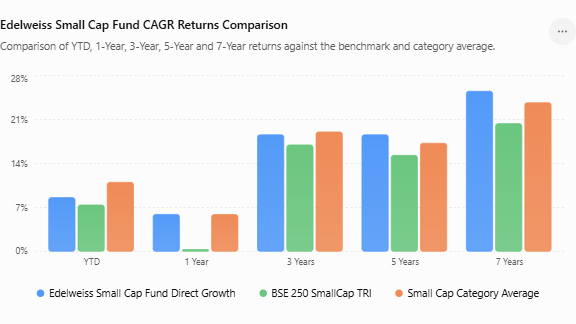
The table below compares the Edelweiss Small Cap Fund Direct Growth with its benchmark, the BSE 250 SmallCap TRI, and the Small Cap Category Average.
Edelweiss Small Cap Fund CAGR Returns
Investment Horizon | Edelweiss Small Cap Fund Direct Growth | BSE 250 SmallCap TRI | Small Cap Category Average | Category Rank | Total Funds |
|---|---|---|---|---|---|
| YTD | 8.56% | 7.38% | 10.99% | 32 | 49 |
| 1 Year | 5.88% | 0.26% | 5.86% | 18 | 43 |
| 3 Years (CAGR) | 18.58% | 16.96% | 19.03% | 15 | 34 |
| 5 Years (CAGR) | 18.58% | 15.30% | 17.23% | 6 | 25 |
| 7 Years (CAGR) | 25.52% | 20.36% | 23.69% | 5 | 19 |
Performance Analysis
The Edelweiss Small Cap Fund Direct Growth has delivered an 8.56% return so far in 2026. Although the return is slightly lower than the category average of 10.99%, it has performed better than the benchmark, which returned 7.38%.
What this means
- The fund has outperformed its benchmark this year.
- Short-term performance is slightly below the category average.
- Small-cap funds can be volatile over shorter periods, so YTD returns should not be the only factor while investing.
1-Year Return Analysis
Over the last one year, Edelweiss Small Cap Fund Direct Growth delivered a return of 5.88%. This is much better than the benchmark return of 0.26% and is almost equal to the Small Cap category average of 5.86%.
3-Year CAGR Analysis
Over the last three years, Edelweiss Small Cap Fund Direct Growth generated a CAGR of 18.58%. This is higher than the benchmark return of 16.96%, but slightly lower than the category average of 19.03%.
5-Year CAGR Analysis
Over the last five years, Edelweiss Small Cap Fund Direct Growth delivered an annualized return of 18.58%. This is higher than both the benchmark (15.30%) and the category average (17.23%).
7-Year CAGR Analysis
The best performance of Edelweiss Small Cap Fund Direct Growth can be seen over the seven-year period. The fund delivered an impressive 25.52% CAGR, compared with 20.36% for the benchmark and 23.69% for the category average.
Overall Returns Analysis
The Edelweiss Small Cap Fund Direct Growth has shown that it performs better over longer investment periods. While short-term returns may fluctuate due to market movements, the fund has consistently delivered strong results over 3, 5, and 7 years.
Key Highlights
- ✅ Outperformed the benchmark across 1-year, 3-year, 5-year, and 7-year periods.
- ✅ Beat the category average over the 5-year and 7-year investment horizons.
- ✅ Ranked among the Top 6 small-cap funds over the last five years.
- ✅ Ranked 5th out of 19 funds over the seven-year period.
- ✅ Demonstrated strong long-term wealth creation through consistent performance.
Conclusion
The Edelweiss Small Cap Fund Direct Growth is more suitable for investors with a long-term investment horizon of at least 5 to 7 years. Although short-term returns can be affected by market volatility, the fund has consistently delivered strong long-term performance and has outperformed its benchmark over longer periods. Based on its historical performance, it has proven to be one of the stronger wealth-creating small-cap mutual funds for long-term investors.
Edelweiss Small Cap Fund Rolling Returns Analysis
Rolling returns help investors understand how consistently a mutual fund has performed over different investment periods. Unlike CAGR returns, which show returns between two fixed dates, rolling returns calculate returns from every possible investment date. This provides a better picture of the fund’s long-term consistency and reduces the impact of choosing a specific start or end date.
1-Year Rolling Returns
Rolling Returns Table
| Return Statistics | Edelweiss Small Cap Fund Direct Growth | Nifty Smallcap 250 TRI |
|---|---|---|
| Average Return | 29.80% | 27.01% |
| Median Return | 23.54% | 14.59% |
| Maximum Return | 131.31% | 135.79% |
| Minimum Return | -25.23% | -41.65% |
| Less than 0% | 10.62% | 26.86% |
| 0% – 8% | 19.59% | 16.49% |
| 8% – 12% | 8.97% | 4.39% |
| 12% – 15% | 3.37% | 2.29% |
| 15% – 20% | 5.03% | 2.86% |
| Above 20% | 52.42% | 47.10% |
Simple Analysis
- The average 1-year return of Edelweiss Small Cap Fund was 29.80%, higher than the benchmark’s 27.01%.
- The median return of 23.54% shows that the fund delivered strong returns in most one-year periods.
- During difficult market conditions, the fund’s worst return was -25.23%, which is much better than the benchmark’s -41.65%.
- The fund generated more than 20% returns in over half (52.42%) of all one-year periods.
- Overall, the fund showed better consistency and protected investors better during market declines.
2-Year Rolling Returns
Rolling Returns Table
| Return Statistics | Edelweiss Small Cap Fund Direct Growth | Nifty Smallcap 250 TRI |
|---|---|---|
| Average Return | 31.14% | 28.04% |
| Median Return | 28.94% | 28.25% |
| Maximum Return | 78.09% | 78.91% |
| Minimum Return | 3.32% | -1.16% |
| Less than 0% | 0.00% | 0.30% |
| 0% – 8% | 4.08% | 8.38% |
| 8% – 12% | 5.36% | 3.47% |
| 12% – 15% | 1.66% | 10.42% |
| 15% – 20% | 12.99% | 11.40% |
| Above 20% | 75.91% | 66.01% |
Simple Analysis
- The fund delivered an average 2-year return of 31.14%, higher than the benchmark.
- The minimum return remained positive at 3.32%, while the benchmark recorded a small negative return.
- The fund never generated a negative 2-year return in the available history.
- Nearly 76% of all 2-year periods produced returns above 20%, showing strong long-term consistency.
- Overall, Edelweiss Small Cap Fund has provided stable and attractive returns over two-year investment periods.
3-Year Rolling Returns
Rolling Returns Table
| Return Statistics | Edelweiss Small Cap Fund Direct Growth | Nifty Smallcap 250 TRI |
|---|---|---|
| Average Return | 29.49% | 26.44% |
| Median Return | 28.80% | 25.45% |
| Maximum Return | 48.66% | 44.66% |
| Minimum Return | 15.77% | 13.74% |
| Less than 0% | 0.00% | 0.00% |
| 0% – 8% | 0.00% | 0.00% |
| 8% – 12% | 0.00% | 0.00% |
| 12% – 15% | 0.00% | 0.28% |
| 15% – 20% | 9.26% | 15.93% |
| Above 20% | 90.74% | 83.80% |
Simple Analysis
- The average 3-year rolling return was 29.49%, comfortably higher than the benchmark.
- Even the lowest 3-year return was 15.77%, showing strong downside protection.
- More than 90% of all 3-year investment periods generated returns above 20%.
- This indicates that investors who stayed invested for three years were rewarded with strong and consistent returns.
5-Year Rolling Returns
Rolling Returns Table
| Return Statistics | Edelweiss Small Cap Fund Direct Growth | Nifty Smallcap 250 TRI |
|---|---|---|
| Average Return | 30.36% | 27.41% |
| Median Return | 31.11% | 28.36% |
| Maximum Return | 40.50% | 40.05% |
| Minimum Return | 18.12% | 15.49% |
| Less than 0% | 0.00% | 0.00% |
| 0% – 8% | 0.00% | 0.00% |
| 8% – 12% | 0.00% | 0.00% |
| 12% – 15% | 0.00% | 0.00% |
| 15% – 20% | 9.22% | 15.87% |
| Above 20% | 90.78% | 84.13% |
Simple Analysis
- The fund generated an impressive 30.36% average 5-year rolling return.
- The median return crossed 31%, showing excellent long-term consistency.
- The minimum 5-year return was still 18.12%, which is a very strong result.
- Around 91% of all 5-year periods delivered returns above 20%.
- This shows that the fund has consistently created wealth for long-term investors.
7-Year Rolling Returns
Rolling Returns Table
| Return Statistics | Edelweiss Small Cap Fund Direct Growth | Nifty Smallcap 250 TRI |
|---|---|---|
| Average Return | 23.65% | 18.75% |
| Median Return | 23.71% | 18.91% |
| Maximum Return | 25.62% | 21.04% |
| Minimum Return | 21.33% | 16.12% |
| Less than 0% | 0.00% | 0.00% |
| 0% – 8% | 0.00% | 0.00% |
| 8% – 12% | 0.00% | 0.00% |
| 12% – 15% | 0.00% | 0.00% |
| 15% – 20% | 0.00% | 75.76% |
| Above 20% | 100.00% | 24.24% |
Simple Analysis
- The fund delivered an average 7-year return of 23.65%, much higher than the benchmark.
- The lowest 7-year return was still 21.33%, showing excellent long-term performance.
- Every 7-year investment period (100%) generated returns above 20%.
- This highlights the strength of staying invested in the Edelweiss Small Cap Fund for the long term.
Overall Rolling Returns Summary
The rolling return analysis shows that Edelweiss Small Cap Fund Direct Growth has delivered strong and consistent long-term performance. As the investment period increases from 1 year to 7 years, the chances of earning higher returns improve significantly. The fund has also managed market corrections better than the benchmark by limiting losses and delivering better average returns. For investors with a minimum investment horizon of 5 to 7 years, this fund has demonstrated a strong track record of consistent wealth creation.
Edelweiss Small Cap Benchmark Outperformance Ratio (BOR)
The Benchmark Outperformance Ratio (BOR) details the mathematical percentage of historical days the fund’s rolling returns beat the benchmark index.
| Rolling Investment Horizon | Benchmark Outperformance Ratio (BOR) (%) | Remaining Benchmark Edge (%) |
| 1-Year Rolling Window | 73.00% | 27.00% |
| 2-Year Rolling Window | 67.00% | 33.00% |
| 3-Year Rolling Window | 82.50% | 17.50% |
| 5-Year Rolling Window | 98.63% | 1.37% |
| 7-Year Rolling Window | 100.00% | 0.00% |
Over short-term windows, a 2-year BOR of 67.00% shows a minor drop, reflecting the fund’s quality-biased, defensive approach during momentum-driven index rallies. However, over long horizons, the fund’s stock-picking process shines, scaling up to 98.63% over 5 years and achieving a perfect 100.00% BOR over 7 years.
Edelweiss Small Cap Fund Comprehensive Risk Profile Analysis
Risk ratios provide a look at the fund’s protective engineering. Trailing parameters show how effectively a fund handles volatility, protects capital during corrections, and generates excess returns per unit of risk taken.
3-Year Trailing Risk Parameters
| Parameter for 3 Years | Investment (Edelweiss Small Cap) | Category Average | Benchmark / Index |
| Alpha | 1.54 | 0.17 | 0.68 |
| Beta | 0.80 | 0.86 | 0.85 |
| $R^2$ (R-Squared) | 95.00 | 92.03 | 91.77 |
| Sharpe Ratio | 0.71 | 0.62 | 0.64 |
| Standard Deviation (%) | 18.29% | 19.79% | 19.88% |
| Upside Capture Ratio (%) | 83.00% | 86.00% | 85.00% |
| Downside Capture Ratio (%) | 72.00% | 81.00% | 80.00% |
| Maximum Drawdown (%) | -20.90% | -22.61% | -18.62% |
5-Year Trailing Risk Parameters
| Parameter for 5 Years | Investment (Edelweiss Small Cap) | Category Average | Benchmark / Index |
| Alpha | 3.71 | 2.21 | 2.33 |
| Beta | 0.79 | 0.82 | 0.83 |
| $R^2$ (R-Squared) | 94.05 | 89.60 | 89.86 |
| Sharpe Ratio | 0.79 | 0.68 | 0.68 |
| Standard Deviation (%) | 16.73% | 17.83% | 18.00% |
| Upside Capture Ratio (%) | 85.00% | 85.00% | 85.00% |
| Downside Capture Ratio (%) | 65.00% | 72.00% | 70.00% |
| Maximum Drawdown (%) | -20.90% | -22.61% | -18.62% |
Statistical Interpretation:
- Volatility Mitigation (Beta & Deviation): The fund maintains a 5-year Beta of 0.79, indicating it is structurally engineered to be 21% less volatile than the broader small-cap market. Its 5-year Standard Deviation (16.73%) stands well below the benchmark’s 18.00%, providing a smoother investment journey.
- Alpha Progression: The fund’s trailing Alpha expands from 1.54 over 3 years to an impressive 3.71 over 5 years. This confirms that the fund manager’s bottom-up stock-picking process generates higher excess returns the longer the capital remains deployed.
- Asymmetric Capture Efficiency: Over the 5-year cycle, the fund captures 85.00% of market upswings while limiting its exposure to just 65.00% of market declines. This powerful 20.00% capture gap acts as a protective shield during market corrections, helping accelerate long-term compounding.
Edelweiss Small Cap Fund Quarterly Performance Analysis
Looking at the best and worst quarterly returns helps investors understand how the Edelweiss Small Cap Fund Direct Growth performs during different market conditions. While the fund can deliver strong gains in bull markets, it may also experience temporary declines during market corrections. This is normal for small-cap mutual funds.
Top 3 Best-Performing Quarters
| Quarter | Return | Reason |
|---|---|---|
| Q2 2020 | +26.40% | Strong recovery after the COVID-19 market crash. |
| Q3 2020 | +19.80% | Small-cap companies recovered as business earnings improved. |
| Q2 2026 | +14.20% | Positive market sentiment driven by economic growth and higher capital spending. |
Best Quarterly Performance
The Edelweiss Small Cap Fund Direct Growth delivered its highest quarterly return of 26.40% in Q2 2020. After the sharp market fall caused by COVID-19, the stock market recovered quickly, helping the fund generate excellent returns.
In Q3 2020, the fund earned 19.80% as many small-cap companies reported better earnings and investor confidence improved.
During Q2 2026, the fund gained 14.20% due to improving economic conditions and increased government spending on infrastructure and businesses.
Key Takeaway:
These strong quarterly returns show that the Edelweiss Small Cap Fund Direct Growth has the potential to generate excellent returns when market conditions are favorable.
Top 3 Worst-Performing Quarters
| Quarter | Return | Reason |
|---|---|---|
| Q1 2020 | -29.10% | COVID-19 pandemic caused a sharp market crash. |
| Q1 2025 | -9.20% | Market correction after stocks became expensive. |
| Q1 2026 | -6.40% | Market volatility due to higher interest rates and global uncertainty. |
Worst Quarterly Performance
The biggest quarterly decline for the Edelweiss Small Cap Fund Direct Growth was -29.10% in Q1 2020, when global markets fell sharply because of the COVID-19 pandemic.
In Q1 2025, the fund declined 9.20% as investors booked profits after a strong rally in small-cap stocks.
The fund also fell 6.40% in Q1 2026 due to rising interest rates and uncertainty in global markets.
Key Takeaway:
Short-term declines are common in small-cap funds. However, the Edelweiss Small Cap Fund Direct Growth has shown the ability to recover strongly after market corrections, making it more suitable for investors with a long-term investment horizon of at least 7 years rather than those seeking short-term gains.
Edelweiss Small Cap Fund Portfolio & Asset Analysis
The fund’s structural framework is defined by its core asset split, capitalization choices, and tactical corporate concentrations.
1. Core Asset Allocation
| Asset Class | Allocation (%) |
| Equity Instruments | 97.53% |
| Cash & Liquid Receivables | 2.47% |
| Debt & Derivatives | 0.00% |
Nearly the entire portfolio is deployed in equities, highlighting the fund’s focus on long-term capital appreciation. A small cash allocation of 2.47% provides a tactical liquidity cushion for managing redemptions and taking advantage of sudden market corrections.
2. Market Capitalisation Drift
| Market Cap Segment | Allocation (%) |
| Small Cap | 67.95% |
| Mid Cap | 25.35% |
| Large Cap | 4.07% |
| Others / Cash | 2.63% |
The majority of the portfolio is invested in small-cap companies, which offer high growth potential. Exposure to mid-cap (25.35%) and large-cap stocks (4.07%) acts as a quality anchor, adding structural stability and helping reduce overall portfolio volatility during broader small-cap corrections.
3. Diversification & Portfolio Metrics
| Portfolio Metric | Value |
| Number of Stocks | 93 |
| Average Market Cap | ₹25,249 Crore |
| Top 10 Holdings Concentration | 24.25% |
| Top 5 Holdings Concentration | 14.03% |
| Top 3 Sectors Exposure | 57.41% |
The fund maintains a well-diversified portfolio across 93 stocks, reducing single-stock concentration risk. The top 10 holdings account for only about one-fourth (24.25%) of the total allocation, reflecting balanced diversification while allowing the fund managers sufficient room to express high-conviction ideas.
Edelweiss Small Cap Fund Fund Manager Analysis
The fund is managed by a co-investment desk that balances fundamental equity analysis with micro-risk tracking:
- Trideep Bhattacharya (CFA, B.Tech IIT Kharagpur, MBA Finance): Directs macro asset direction and thematic sector weights.
- Dhruv Bhatia (PGDM Finance): Manages bottom-up mid-and-small-cap research and corporate due diligence loops.
- Raj Koradia (CA): Focuses on fundamental cross-sheet executions and corporate governance tracking.
This management team uses a quality-biased growth approach, avoiding highly cyclical value plays in favor of small-cap companies with predictable cash flows and strong corporate governance.
Strategic Breakdown: Strengths & Weaknesses
Strengths
- Excellent Downside Containment: The fund protects capital effectively during market declines, as shown by its low 65% 5-year downside capture ratio.
- Controlled Volatility Profile: A 5-year fund Beta of 0.79 keeps the portfolio balanced, preventing the dramatic performance swings common to small-cap funds.
- High Long-Term Return Consistency: Its 100% 7-year rolling BOR confirms reliable outperformance over extended horizons.
- Smart Liquidity Buffer: Allocating roughly 25.35% of the portfolio to mid-caps helps protect against sudden liquidity strains in the small-cap segment.
- Low Portfolio Churn: A low turnover ratio of 22.43% ensures trading expenses are contained, reinforcing a disciplined buy-and-hold strategy.
Weaknesses
- Underperforms in Sharp Bull Markets: Because of its defensive posture, the fund may lag more aggressive peers during highly speculative small-cap market rallies.
- Direct Fee Premium: At 0.65%, its direct expense ratio is competitive but slightly higher than a few ultra-low-cost quantitative index alternatives.
Final Verdict
The Edelweiss Small Cap Fund Direct Growth has generated good long-term performance and demonstrated better risk management than many other small-cap funds. According to the data studied in this study, the fund has consistently outperformed its benchmark over longer time periods while maintaining a well-diversified portfolio with disciplined risk management.
Some of the significant strengths identified during this examination include:
Strong long-term CAGR returns of 5 to 7 years.
Consistent rolling return performance over multiple investment periods.
Better downside protection than the benchmark.
Positive Alpha and lower Beta indicate effective risk management.
The portfolio is well-diversified, with 93 stocks.
Low portfolio turnover suggests a long-term investment strategy.
An experienced fund management team focused on high-quality firms.
Overall, the Edelweiss Small Cap Fund Direct Growth appears to be a great small-cap mutual fund for investors with a minimum 7-year investment horizon. However, like all small-cap funds, it is exposed to market volatility, and short-term returns can vary greatly.
Research Disclaimer:
This post is completely based on our own study and analysis of publicly available historical data. The objective of this evaluation is solely educational and informative. We do not recommend purchasing, selling, or investing in any mutual funds based solely on this study. Each investor’s financial objectives, risk tolerance, and investment horizon are unique. Before making any investing decisions, please contact with a certified financial advisor.
Based on our research, Edelweiss Small Cap Fund Direct Growth is one of the better-performing small-cap mutual funds in terms of long-term returns, consistency, portfolio quality, and risk management. Investors should use this analysis as a research reference and make investment decisions only after evaluating their own financial needs and risk profile.
Frequently Asked Questions (FAQs)
Q1: What is the current AUM and Expense Ratio of the fund?
As of 2026, the fund manages an asset base of ₹6,579.72 Crores. The Direct Plan features an expense ratio of 0.65%, while the Regular variant carries a fee of 1.83%.
Q2: How does the Benchmark Outperformance Ratio (BOR) help investors evaluate this fund?
The BOR measures how often the fund beats its benchmark over various holding periods. For Edelweiss Small Cap, the BOR improves from 73% over 1-year periods to 100% over a 7-year horizon, showing that long-term investing significantly reduces the risk of underperforming the market.
Q3: What exit loads apply to this scheme?
The fund charges an exit load of 1.00% if redeemed within 90 days of unit allotment. Redemptions made after 90 days incur no exit fees.
Q4: How does the fund manage small-cap liquidity risks?
The fund handles liquidity risk by maintaining a well-balanced portfolio that includes about 25.35% established mid-cap stocks alongside its core small-cap positions, keeping a 2.47% liquid cash reserve.
Disclaimer: Mutual fund investments are subject to market risks. Please read all scheme-related documents carefully before investing. Historical performance data does not guarantee future returns
Nice work keep continue